API Version
For Kubernetes functionalities and resources to be created, new APIs are also needed.
Stable versions are what we call
V1.
But we encounter several different versions along the way and let's understand how they appear.
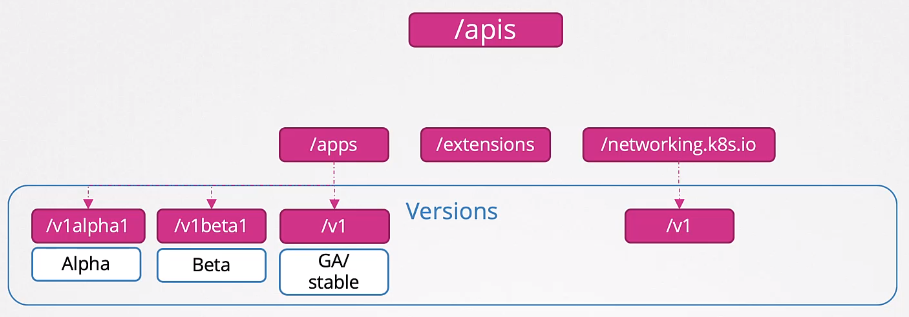
Explaining each of them better:
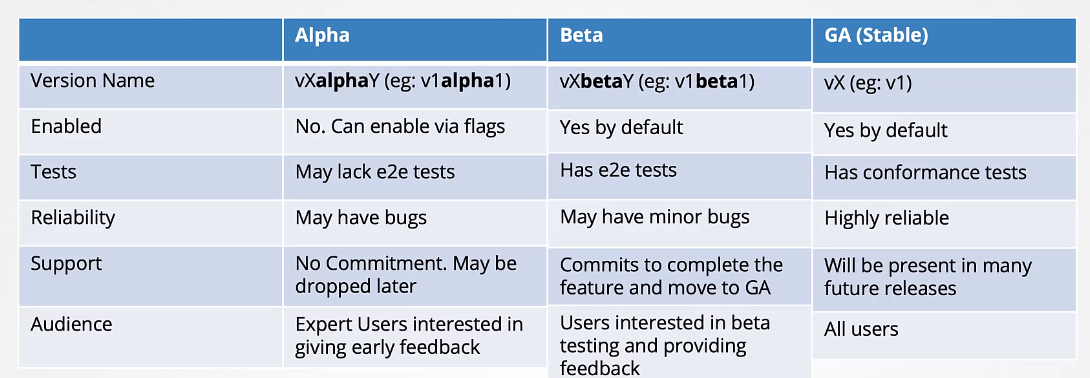
Alpha
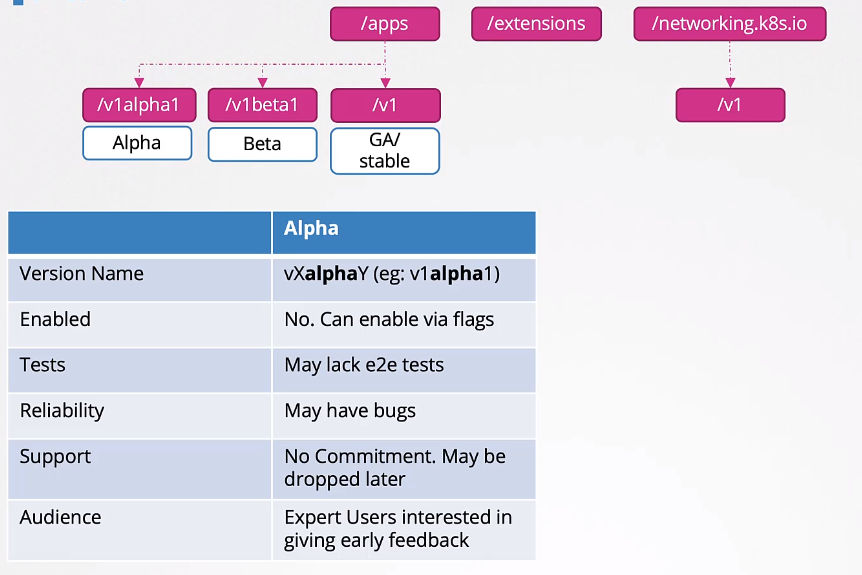
When an API has just been included in the Kubernetes code for the first time
It's not available by default and needs to be enabled to be used.
It may still have bugs and can be deprecated quickly. It's generally used by users who are interested in giving their feedback and collaborating with Kubernetes. Should not be used in production.
Creating an alpha object that's not enabled won't work.
Beta
Moving forward a bit from the alpha version with bugs already fixed, we have beta.
This one is available by default, may still contain minor errors, but has already been tested and approved including end-to-end tests. The tendency is for them to become v1 in the future, but it's not guaranteed.
GA Stable
After a few months and a few releases, betas move to GA which are considered the stable versions we know as v1. They're much more reliable and will be present in several future Kubernetes releases and can be used by all users.
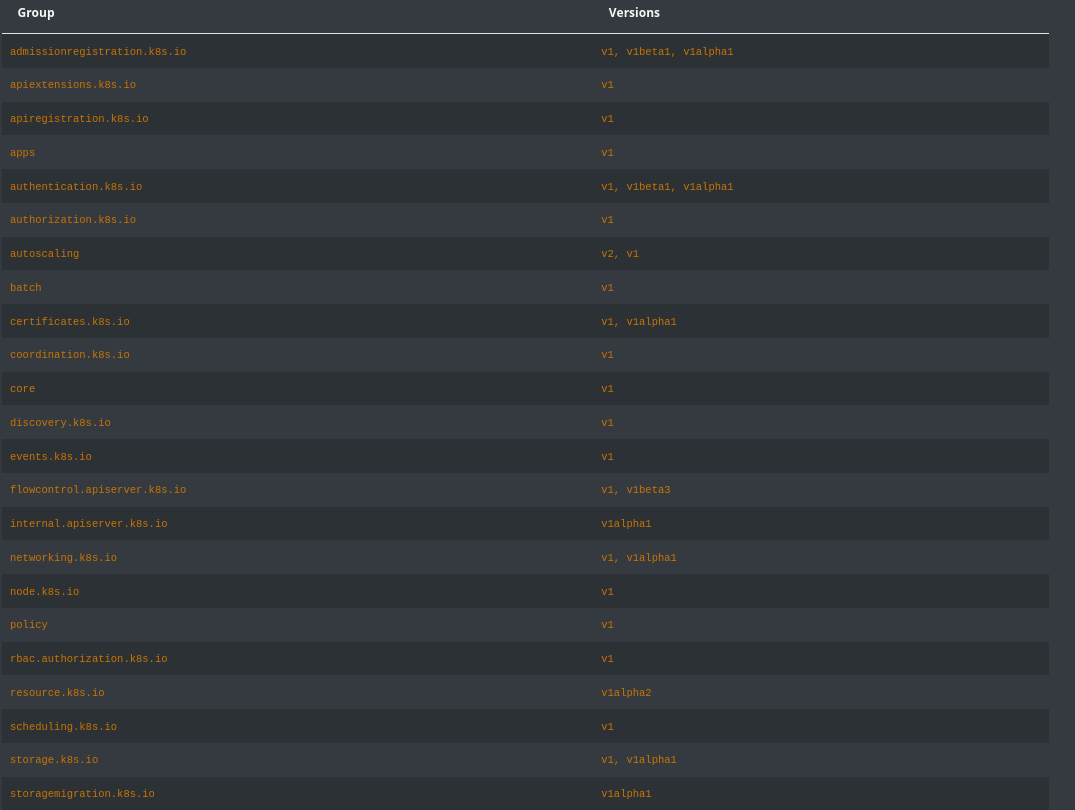
Here we have an example of Kubernetes version 1.30.
If you want to search for other versions
An example of evolution:
| API GROUP | 1.25 | 1.26 | 1.27 | 1.28 | 1.29 | 1.30 |
|---|---|---|---|---|---|---|
| admissionregistration.k8s.io | v1 | v1, v1alpha1 | v1, v1alpha1 | v1, v1beta1, v1alpha1 | v1, v1beta1, v1alpha1 | v1, v1beta1, v1alpha1 |
| apiextensions.k8s.io | v1 | v1 | v1 | v1 | v1 | v1 |
| apiregistration.k8s.io | v1 | v1 | v1 | v1 | v1 | v1 |
| apps | v1 | v1 | v1 | v1 | v1 | v1 |
| authentication.k8s.io | v1 | v1, v1alpha1 | v1, v1beta1, v1alpha1 | v1, v1beta1, v1alpha1 | v1, v1beta1, v1alpha1 | v1, v1beta1, v1alpha1 |
| authorization.k8s.io | v1 | v1 | v1 | v1 | v1 | v1 |
| autoscaling | v1, v2, v2beta2 | v2, v1 | v2, v1 | v2, v1 | v2, v1 | v2, v1 |
| batch | v1 | v1 | v1 | v1 | v1 | v1 |
| certificates.k8s.io | v1 | v1 | v1, v1alpha1 | v1, v1alpha1 | v1, v1alpha1 | v1, v1alpha1 |
| coordination.k8s.io | v1 | v1 | v1 | v1 | v1 | v1 |
| core | v1 | v1 | v1 | v1 | v1 | v1 |
| discovery.k8s.io | v1 | v1 | v1 | v1 | v1 | v1 |
| events.k8s.io | v1 | v1 | v1 | v1 | v1 | v1 |
| flowcontrol.apiserver.k8s.io | v1beta2, v1beta1 | v1beta3, v1beta2 | v1beta3, v1beta2 | v1beta3, v1beta2 | v1, v1beta3 | v1, v1beta3 |
| internal.apiserver.k8s.io | v1alpha1 | v1alpha1 | v1alpha1 | v1alpha1 | v1alpha1 | v1alpha1 |
| networking.k8s.io | v1, v1alpha1 | v1, v1alpha1 | v1, v1alpha1 | v1, v1alpha1 | v1, v1alpha1 | v1, v1alpha1 |
| node.k8s.io | v1 | v1 | v1 | v1 | v1 | v1 |
| policy | v1 | v1 | v1 | v1 | v1 | v1 |
| rbac.authorization.k8s.io | v1 | v1 | v1 | v1 | v1 | v1 |
| resource.k8s.io | v1alpha1 | v1alpha2 | v1alpha2 | v1alpha2 | v1alpha2 | |
| scheduling.k8s.io | v1 | v1 | v1 | v1 | v1 | v1 |
| storage.k8s.io | v1, v1beta1 | v1, v1beta1 | v1 | v1 | v1, v1alpha1 | v1, v1alpha1 |
| storagemigration.k8s.io | v1alpha1 |
We can observe that Kubernetes supports multiple versions at the same time to provide support for previous versions.
We can observe that the API group offers support for multiple versions at the same time. This means we'll be able to create the same object using any of these versions.
Although it supports multiple versions, only one can be the preferred or stored version.
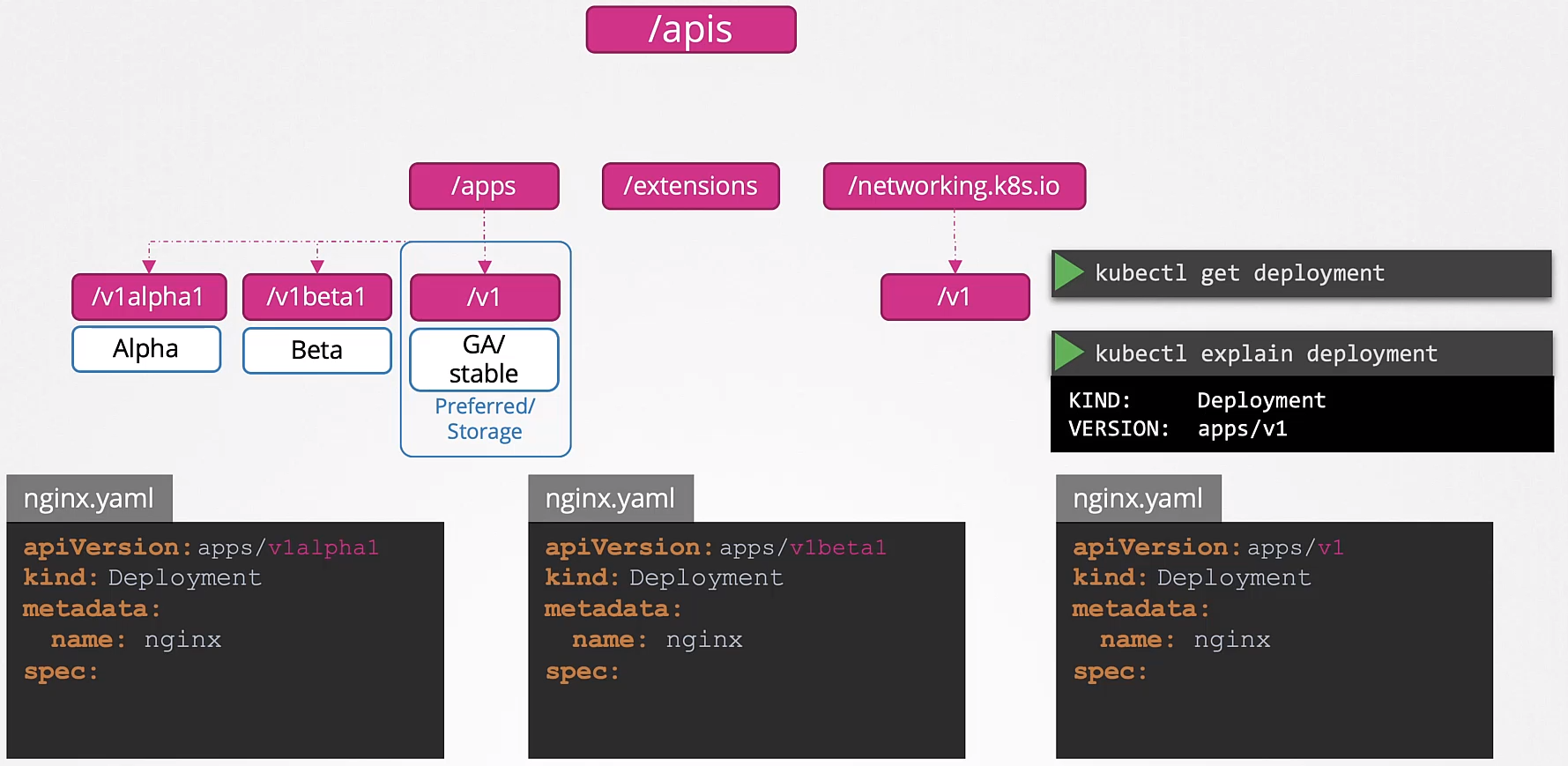
The preferred version is the one that's retrieved by the kubectl command and the stored one is the one that's stored in etcd.
When a version is defined different from the preferred one, it's converted to the preferred version.
> kubectl proxy
Starting to serve on 127.0.0.1:8001

❯ curl http://localhost:8001/apis/batch
{
  "kind": "APIGroup",
  "apiVersion": "v1",
  "name": "batch",
  "versions": [
    {
      "groupVersion": "batch/v1",
      "version": "v1"
    }
  ],
  "preferredVersion": {
    "groupVersion": "batch/v1",
    "version": "v1"
  }
}
To observe what we have inside etcd, it's necessary to search in etcd itself.
To enable alpha versions, we can pass the parameter to the kube-api-server service.
In the case of enabling version v2alpha1 of batch, we can pass
--runtime-config=batch/v2alpha1
The service needs to be restarted if it's a static pod or service in the operating system.