Provider Lab Part 1
Let's create a lab with everything we need for our Crossplane study. The proposal is to create a lab with several providers of things we use in our daily work.
We'll reuse the Backstage lab and add Crossplane, but we'll add several extra providers to be able to explore different scenarios in the future.
We'll install using the values.yaml below.
Provider GitHub
Apply the yaml below.
apiVersion: pkg.crossplane.io/v1
kind: Provider
metadata:
  name: provider-github
spec:
  package: xpkg.upbound.io/coopnorge/provider-github:v0.13.0
Let's configure the GitHub provider using a personal token.
Let's create a secret containing inside credentials the token and owner which are the values it needs to fetch.
Create the github.yaml file
# github.yaml
apiVersion: v1
kind: Secret
metadata:
  name: github-davidpuziol # Secret name, change to yours
  namespace: crossplane-system
type: Opaque
stringData:
  credentials: "{\"token\":\"${GITHUB_TOKEN}\",\"owner\":\"${GITHUB_ACCOUNT}\"}"
---
apiVersion: github.upbound.io/v1beta1
kind: ProviderConfig
metadata:
# This is a github provider config as we can see by the apiversion.
# A good practice is that by the name we can already know which account will be used
# Change to your account to make it easy.
  name: github-provider-davidpuziol
spec:
  credentials:
    source: Secret
    secretRef:
      name: github-davidpuziol # Will reference the secret we created above.
      namespace: crossplane-system
      key: credentials
Each provider has its own Kind ProviderConfig which uses its own apiVersion.
We can have several provider configs for the same provider type. For example two different GitHub accounts.
Now let's apply what we have above.
export GITHUB_TOKEN="your-token"
export GITHUB_ACCOUNT="your-account"
# As yaml doesn't have the capability to substitute variables, we should do this before applying.
envsubst < gitlab.yaml | kubectl apply -f -
To test let's apply the manifest below to create a new repository.
apiVersion: repo.github.upbound.io/v1alpha1
kind: Repository
metadata:
  name: test-repo-crossplane
  namespace: default
spec:
  forProvider:
    name: test-repo-crossplane
    description: "Test repository created via Crossplane"
    visibility: "public"
    hasIssues: true
    hasWiki: true
    autoInit: true
  providerConfigRef:
    name: github-provider-davidpuziol # See that we are using this provider config, so it goes to my account.
kubectl apply -f githubrepotest.yaml
repository.repo.github.upbound.io/test-repo-crossplane created
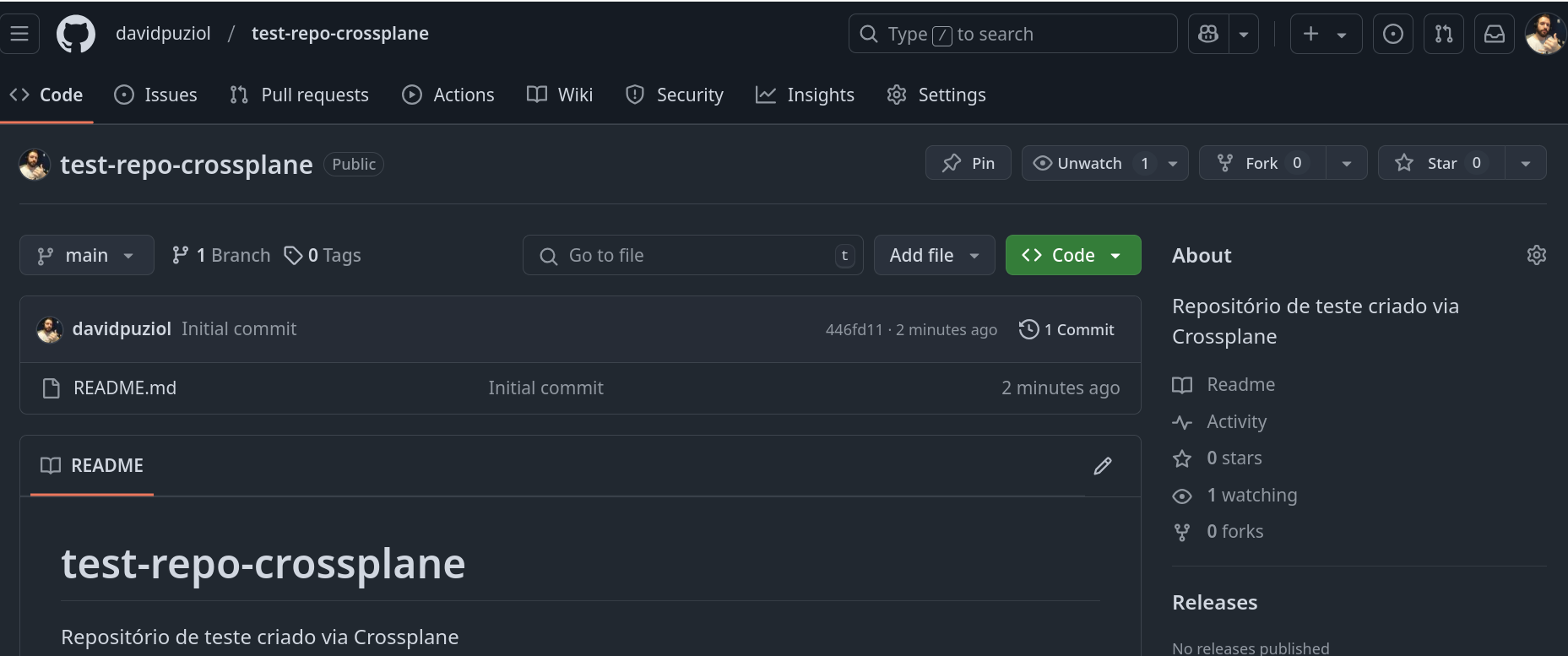
A curiosity is that this resource is cluster scope, meaning even though we defined the default namespace, it doesn't matter. Actually all GitHub custom resources are at cluster level.
❯ k get repositories.repo.github.upbound.io -n default
NAME                   SYNCED   READY   EXTERNAL-NAME          AGE
test-repo-crossplane   True     True    test-repo-crossplane   2m2s

❯ k get repositories.repo.github.upbound.io -n crossplane-system
NAME                   SYNCED   READY   EXTERNAL-NAME          AGE
test-repo-crossplane   True     True    test-repo-crossplane   2m15s
Deleting this resource.
kubectl delete repositories.repo.github.upbound.io test-repo-crossplane
repository.repo.github.upbound.io "test-repo-crossplane" deleted

Several new custom resources were created for GitHub use, despite us using repositories.repo.github.upbound.io.
k get customresourcedefinitions.apiextensions.k8s.io -n crossplane-system -o custom-columns=NAME:.metadata.name | grep github.upbound.io

actionssecrets.actions.github.upbound.io
actionsvariables.actions.github.upbound.io
branches.repo.github.upbound.io
branchprotections.repo.github.upbound.io
defaultbranches.repo.github.upbound.io
deploykeys.repo.github.upbound.io
emugroupmappings.team.github.upbound.io
memberships.user.github.upbound.io
organizationrulesets.enterprise.github.upbound.io
organizations.enterprise.github.upbound.io
providerconfigs.github.upbound.io
providerconfigusages.github.upbound.io
pullrequests.repo.github.upbound.io
repositories.repo.github.upbound.io
repositoryautolinkreferences.repo.github.upbound.io
repositoryfiles.repo.github.upbound.io
repositorywebhooks.repo.github.upbound.io
storeconfigs.github.upbound.io
teammemberships.team.github.upbound.io
teamrepositories.team.github.upbound.io
teams.team.github.upbound.io
teamsettings.team.github.upbound.io
teamsyncgroupmappings.team.github.upbound.io
Provider GitLab
We create the secret with the token we need.
apiVersion: v1
kind: Secret
metadata:
  name: gitlab-davidpuziol
  namespace: crossplane-system
type: Opaque
stringData:
  token: "${GITLAB_TOKEN}"
---
apiVersion: gitlab.crossplane.io/v1beta1
kind: ProviderConfig ## Once again see that it's kind ProviderConfig for a different apiVersion.
metadata:
  name: gitlab-provider-davidpuziol
  namespace: crossplane-system
spec:
  baseURL: https://gitlab.com/
  credentials:
    source: Secret
    method: PersonalAccessToken
    secretRef:
      namespace: crossplane-system
      name: gitlab-davidpuziol
      key: token
And we have the custom resources below, all at cluster level too.
k get customresourcedefinitions.apiextensions.k8s.io -n crossplane-system -o custom-columns=NAME:.metadata.name | grep gitlab.crossplane.io
accesstokens.groups.gitlab.crossplane.io
accesstokens.projects.gitlab.crossplane.io
deploykeys.projects.gitlab.crossplane.io
deploytokens.groups.gitlab.crossplane.io
deploytokens.projects.gitlab.crossplane.io
groups.groups.gitlab.crossplane.io
hooks.projects.gitlab.crossplane.io
members.groups.gitlab.crossplane.io
members.projects.gitlab.crossplane.io
pipelineschedules.projects.gitlab.crossplane.io
projects.projects.gitlab.crossplane.io
providerconfigs.gitlab.crossplane.io
providerconfigusages.gitlab.crossplane.io
samlgrouplinks.groups.gitlab.crossplane.io
storeconfigs.gitlab.crossplane.io
variables.groups.gitlab.crossplane.io
variables.projects.gitlab.crossplane.io
To create a repository it would be a different custom resource from GitHub. In GitLab we define a project.
apiVersion: projects.gitlab.crossplane.io/v1alpha1
kind: Project
metadata:
  name: test-project-crossplane
  namespace: default
spec:
  forProvider:
    name: test-project-crossplane
    description: "Test project created via Crossplane"
    visibility: private
    initializeWithReadme: true
  providerConfigRef:
    name: gitlab-provider-davidpuziol
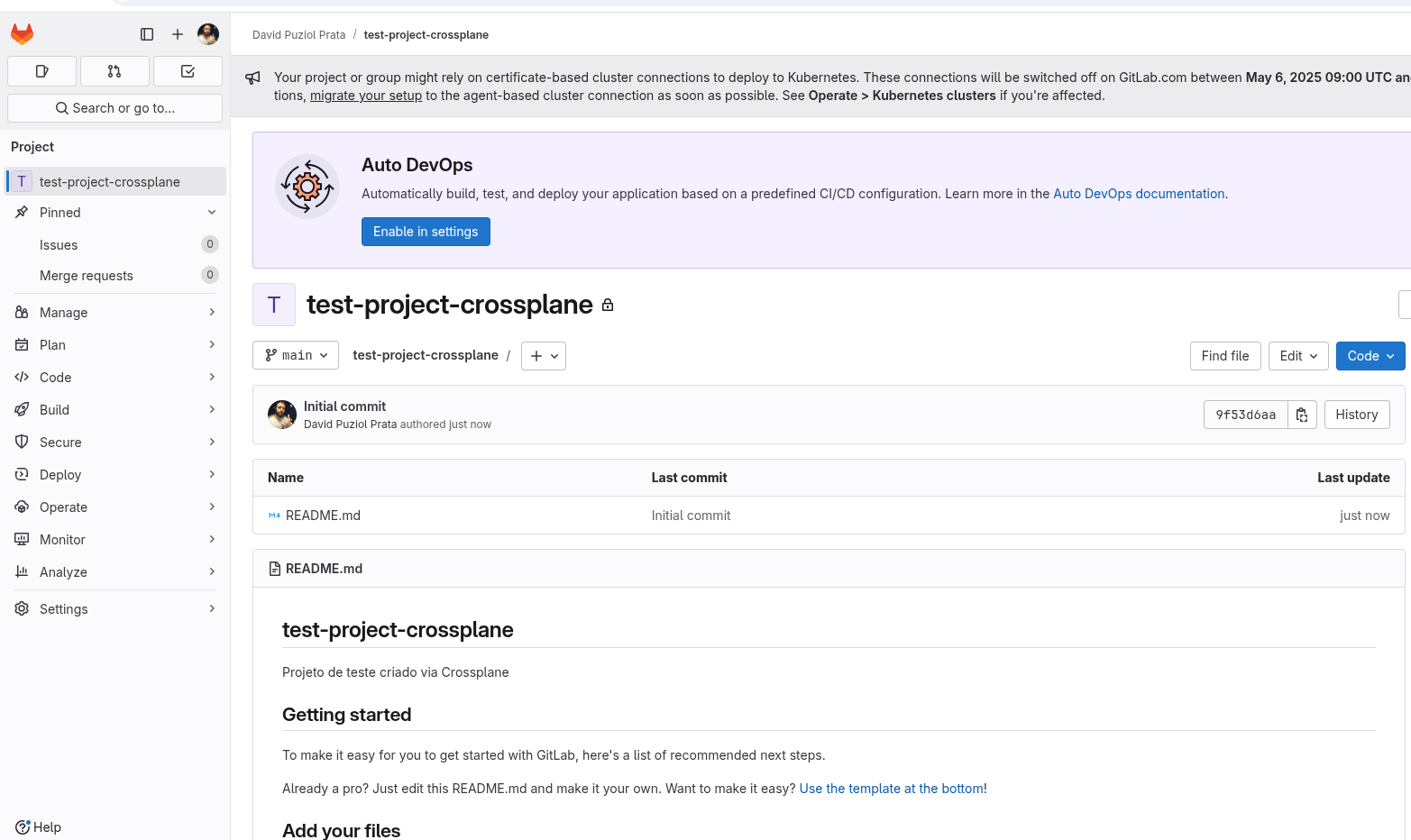
Applying this manifest we have.
kubectl apply -f /docs/iac/crossplane/resources/providers-configs/gitlabrepo.yaml
project.projects.gitlab.crossplane.io/test-project-crossplane created

k get projects.projects.gitlab.crossplane.io
NAME                      READY   SYNCED   AGE   PATH WITH NAMESPACE
test-project-crossplane   True    True     23s   davidpuziol/test-project-crossplane
To delete.
❯ k delete projects.projects.gitlab.crossplane.io test-project-crossplane
project.projects.gitlab.crossplane.io "test-project-crossplane" deleted