The Art of Learning: How to Build Your Own Path in Knowledge
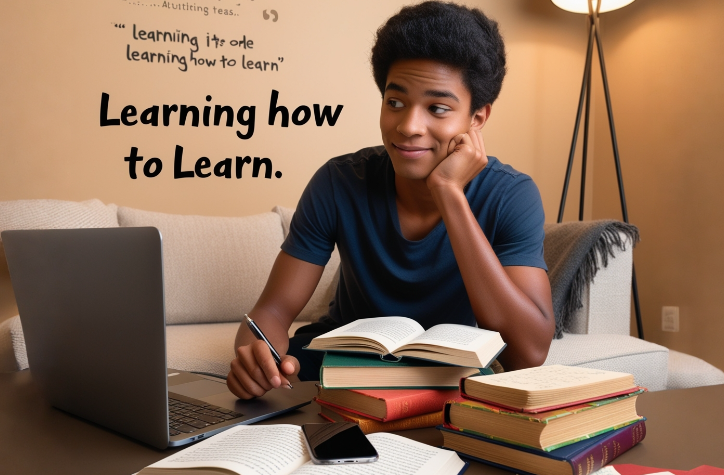
There is no single correct way to learn, as each person absorbs content differently. For example, to memorize a mathematical formula, many people use phrases or songs. I, on the other hand, could only learn by understanding the origin of the formula. I was always someone who paid close attention in class and didn't study much at home, but still did well on tests. My wife, on the other hand, needed to study a lot to achieve the same result.
The first lesson from this is that constant effort produces better results than simply relying on intelligence.
It's not that I didn't like studying; I just hadn't discovered how to make studying enjoyable. Ironically, I ended up learning how to truly study after leaving college. It was when I needed to build a portfolio to showcase my knowledge and seize market opportunities that I finally discovered my learning method. However, I realized that my method doesn't work for everyone.
I discovered that the best way to learn, for me, is by creating material to teach others. When I need to explain something, that's when I learn the most. However, this can't be done orally; I need to write to absorb knowledge. The only downside is that I'm not particularly good at writing, so on this site, you'll probably find some errors. For me, what matters is recording what I studied, not wasting time on grammar reviews or corrections.
Speaking of memory, no one can remember everything they studied all the time. It's humanly impossible. If we spend a year without contact with a subject, we'll inevitably forget part of it. However, the process of remembering is faster than the initial study. For me, the primary goal of this site is to help me remember what I studied, and the secondary benefit is being able to contribute to the community in some way.
It reached a point where I had so much material that it became difficult to organize everything, and that's when the idea of creating the site emerged: to centralize my notes and research. There's still a lot of content to be added, but time is always short.
Back to the topic, each person needs to find pleasure in studying to evolve continuously. In the professional world, one thing is certain: "when the market accumulates many people and demand falls, the least capable are the first to leave."
We are what we deliver. If your delivery is limited, there will always be someone willing to do the same for a lower price.
Furthermore, the market is constantly changing. New specialties emerge while others disappear. If you don't know how to study, you won't be able to make this transition or take advantage of new opportunities.
In schools, we always had books to follow, and we knew what would be on the test. But in professional life, it's different: problems are unpredictable, and we often need to study on the spot to solve them. That's why pleasure in studying is essential. Unfortunately, I see schools still following this closed curriculum methodology, which makes me question whether we shouldn't fight for a change in this paradigm, especially for our children. Perhaps this type of change should happen in elementary school, after reading and writing are well developed.
Today, there are many courses available on various online learning platforms. Most follow this same methodology: closed curriculum, step by step, and a test at the end — or sometimes not even that. While these courses can be useful as an introduction, few offer the necessary depth. For those working in IT, my tip is: official documentation is the main reference, and many courses just repeat what's already there. A good starting point is studying for certifications, even if you don't plan to take them, as they offer an initial study roadmap.
There is no perfect study curriculum. The more you understand the context around what you need to solve, the easier it will be to find an accurate solution. The important thing is to have a solid knowledge base.
I don't know if you've ever been in a classroom where the vast majority of students failed, but the parents gathered and pressured the school, saying that if the students couldn't pass, then the problem is with the teacher. To avoid such problems, teachers end up applying simpler questions at the end, where everyone passes, and they still come out as a "good teacher." This is a realistic situation of education in many places, where to achieve better scores, the requirements on students are reduced.
What a simple course on platforms does is avoid failure. If, at the end of the course, it gives you simple questions to solve, it's just so you feel like you learned and leave happy thinking you know the material, rating the course well. But the truth is you still don't know much. What you learned was to follow a step-by-step guide; you weren't a student, you were a disciple who just does what the master commands. A good student doubts even what the teacher says, and should, because there are many people without the necessary background teaching.
Hence comes the point about being self-taught. No one needs to be self-taught, but everyone needs to know how to learn alone. If you think taking a course and then going to the official documentation is being self-taught, you're not. You're gathering lots of information and absorbing knowledge, but you're not developing knowledge. There's nothing wrong with that, quite the contrary, you're doing it right, you're learning correctly something already created. What happened here is that no one needed to hold your hand and teach step by step; you went after it alone, that is, you were proactive, and that's one of the characteristics a good professional needs to have in the market.
I particularly feel that learning at my own pace, without having to prove what I know on a test, is much more enjoyable than doing it out of obligation. When we study something more deeply, we discover even more things to study, and this becomes infinite, but it's good.
A great learning method is solving problems. The problem appears and you have to chase after it, but they didn't give you the path of stones, just the problem.
- No classes: just the problem.
- No material: to force people to find the materials they need.
- No supervision: to create a sense of autonomy and responsibility.
The student should just receive a bunch of problems to solve, without books, without teaching materials, without any step-by-step guide, and use their colleagues and teachers to answer specific questions. This is because the first thing students should learn to do is formulate questions that make sense. The world is disorganized, complex, and chaotic, and only those who know how to ask the right questions can move forward.
The right answer comes with the correct question.
Applying the famous figure it out approach is forming a person prepared for the future. It's like riding a bike without training wheels, falling and trying again. This isn't being mean, this is being an educator.
The pleasure of a self-taught person is proving to themselves that they can withstand pain, and for that, it's necessary to get used to it. If we want to create self-taught people, the path is to figure it out.
They say that if it's not hurting, then we're not trying hard enough. Frustration, demotivation, anxiety, and stress are part of the process, but they create a strong person. Things in life aren't easy; everything needs to be conquered, even knowledge.
Have you heard of this cycle? It's very true, so think about what will happen with all this Artificial Intelligence in the market doing things for us.
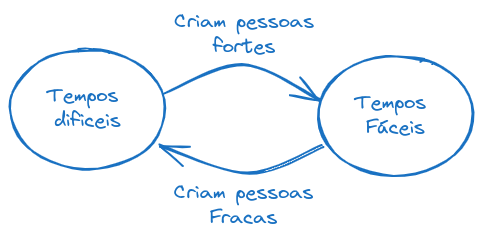
There's no longer the excuse that people in the past didn't have access to information and, therefore, couldn't progress in life. I understand that there are extreme difficulties that many people face, but whoever is reading this text, especially you who made it this far, has no more justifications. Information is everywhere; it's just a matter of searching and having the will to learn. Anyone can change their life nowadays. Therefore, we should no longer feel sorry for those people who claim they don't know how to do something. The truth is that, often, they simply DON'T WANT TO DO IT. Today, we no longer need to make copies of handouts, books, or even print anything. Knowledge is accessible in the palm of your hand.
A person may have talent for something, but no one is born knowing. Everyone needs to pursue knowledge. The difference between one person and another lies in the amount of deliberate practice each one has performed. This involves how focused and concentrated the person is in their learning.
Learning involves first acquiring the base knowledge and then growing and expanding the circle.
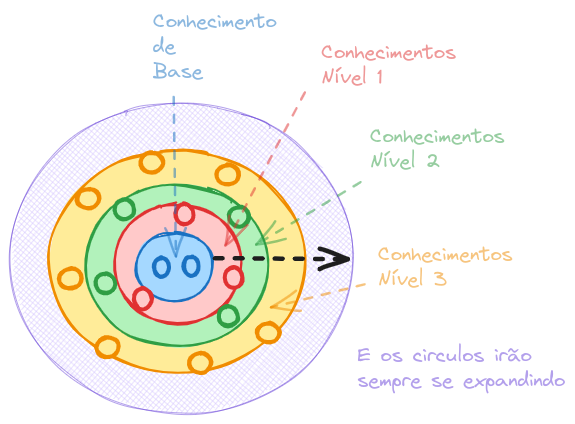
Going back a bit to the DevOps side where I can relate this circle better, without a foundation in operating systems, you'll never truly understand how many things work going forward.
Any knowledge has some initial base that can be expanded. Don't skip steps.