How to Set and Achieve Goals
Anyone can set an ambitious goal, but how many of us manage to achieve it? Often, when we embark on a seemingly smooth journey, it turns out to be treacherous and impossible to climb.
The goal-setting process is as important as choosing goals that really matter. We should set goals that accurately reflect your purpose and find tools you can use to monitor your progress.
It's easy to postpone goal setting. We might think: "I'll figure this out along the way" or "As long as I work hard, it doesn't matter how I get there." But without objectives, we often find ourselves wandering in the wrong direction.
Defining a Goal
Defining a goal is more than just a desired decision to "wake up earlier" or "learn a new tool." Rather, it's a process that requires two main elements: an Objective and a Method.
A goal is a desirable future event. It's something clear, specific, and determined. And it often includes a period within which you expect to achieve this objective: "my goal is to get the CKA certification in 6 months."
A method is a process. It describes HOW to achieve a goal and is often recurring. For example: "My method is to study 2 hours a day between 8:00 PM and 10:00 PM following what the exam requires and do exercises within this period."
Goal setting consists of selecting a target and deciding what process you'll use to achieve that objective and centralize your focus. Along the way, you'll need to avoid distractions, resist short-term incentives to not deviate from the path, and focus on the final objective.
Goal setting requires sacrifices. It's necessary to pay a price to achieve objectives.
When creating your method, think about the reward you want and the price you're willing to pay for it. If the goal is to lose weight, then you'll need to exercise, sleep earlier to not eat at night, avoid sweets, etc. If your goal is to pass an exam, you'll need to avoid distractions, series during the week, learning other technologies along the way, etc.
Why is goal setting important?
Short-term sacrifices lead to several long-term benefits.
Builds motivation - When you set a goal, you're declaring your determination to achieve something meaningful. This transcends the "hope" stage and moves into action, directing your energy in a positive way. A goal serves as an endpoint to be reached, strengthening your commitment and serving as the foundation for your motivation.
Gives you direction - Goals offer a precise target you can hit, allowing you to understand which behaviors are worth spending time on and which should be avoided. Thus, instead of "going with the flow" aimlessly and leaving your ambitions to chance, goals help you establish a productive plan, make informed decisions, and channel your energy in ways that make a positive difference.
Promotes discipline and growth - Goals provide a clear objective, guiding you on which behaviors are important and which should be avoided. Instead of navigating aimlessly and leaving your ambitions to chance, goals help establish a productive plan, make informed decisions, and direct your energy in ways that cause a positive impact.
Provides a measurement tool. By setting goals with defined commitments and determined deadlines, you can measure your progress, evaluate the effectiveness of your actions, and adjust course as needed. Measurable results eliminate surprises, as any problem is identified early, allowing revisions and adjustments to achieve the objective more effectively.
Helps maintain momentum. By monitoring results throughout the process, your aspirations become more tangible and realistic. You'll observe a growing distance between your starting point and your current position. Seeing progress directly stimulates perseverance, keeps your motivation high, and drives the achievement of additional short-term milestones.
When should I set goals?
Many companies have their own career management systems, in which they set goals for their employees. However, regardless of company policies, it's highly beneficial to set personal goals at the beginning of each year. When your personal goals are aligned with the company's, this demonstrates your commitment to continuous professional growth and integral development.
In addition to professional goals, it's important to establish objectives that promote quality of life, such as waking up early, maintaining a healthy diet, and reserving time for family on weekends. These personal goals are essential for achieving a healthy balance between personal and professional life.
SMART Methodology
Simply saying "I want..." isn't enough to achieve our objectives. Grand ambitions, like "I want to be promoted to manager," only materialize when accompanied by a detailed and achievable plan. Without a defined starting line or a clear plan of how to achieve our objectives, we're destined for failure.
In short, method is crucial. To achieve something meaningful, it's essential to focus on the objective and create a clear vision of the path to travel.
To define an adequate goal, it's essential to follow a process that takes into account your main priorities and the practical steps to achieve them. This means starting from general to specific. Following this process diligently significantly increases the chances of success.
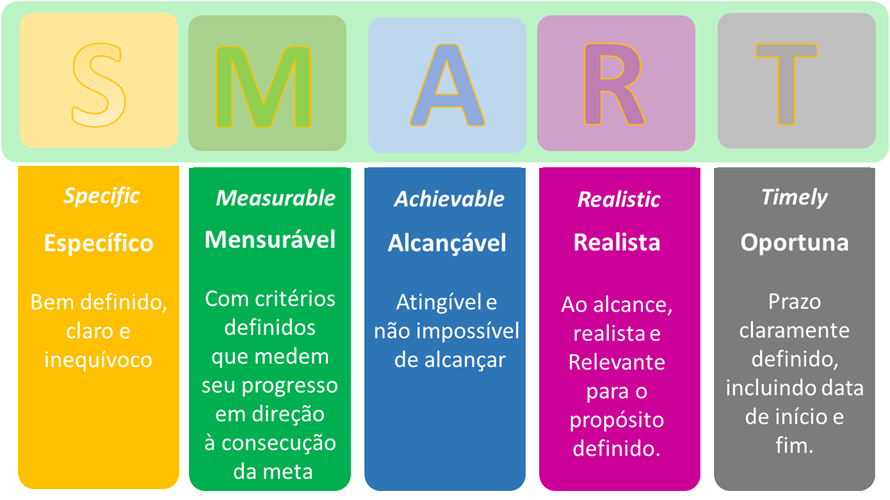
-
S - Specific - Is your objective specific and well-defined? Clarity is the foundation of effective goals and is critical in all aspects of the SMART model. It's necessary to be specific about long and short-term objectives to be achieved, along with defining the strategy to achieve each result. A specific goal usually answers the five questions:
- What - What do I want to accomplish?
- Why - Specific reasons, purpose, or benefits for achieving the goal.
- Who - Who is involved?
- Where - Identify environmental constraints.
- Which - Analyze requirements and constraints.
-
M - Measurable - Can you track your objective? How exactly will you know if you've achieved the goal? How will you measure progress along the way and evaluate if you're advancing in the right direction and at the right pace?
- Quantity
- Quality
- Timelines
- Cost that can be measured objectively.
-
A - Achievable (Ambitious and Attainable) - Is this objective achievable, but challenging? Goals that are difficult, but achievable, produce the best results and are a powerful motivator. If it's a team objective, specify how they will accomplish each of the steps along the way. Team discussions about goal strategy help drive knowledge transfer and clarity around expectations. An achievable goal usually answers the questions:
- How can the objective be achieved?
- Is the objective challenging, but within reason?
-
R - Realistic (Realistic and Relevant). Is this goal relevant and realistic for you? If we're talking about objectives in a business team, we need to align with the company's objectives. When teams develop goals aligned with organizational objectives, team members understand the importance of their work and feel a greater sense of purpose and motivation. Alignment with broader objectives also helps identify priorities when time and resources are limited.
- How does the goal align with organizational objectives?
-
T - Timely (Time) - Does your goal have a deadline? Setting a clear deadline for the overall goal, along with milestone dates to evaluate progress, helps create a sense of urgency and directs focus on key actions that are critical to success.
- Does the specific goal have a date or time period by which it needs to be completed?
- How will we show the evolution/time of the goal to the people who are responsible for achieving the goal?
A variation of the SMART methodology is SMARTER, but generally applied in scenarios where someone is tracking your evaluation or at the project level.
-
E - Evaluable (Regularly Evaluated) - After setting your objectives, you're still not done! It's fundamental that leaders also track goals. Progress and results need to be evaluated regularly. How often goals are evaluated depends on the nature of the goals and how you operate, but in most cases, goals should be reviewed monthly, or quarterly depending on the longevity of the goal.
- How are we progressing?
- Are we on track to hit our next milestone?
- What wins have we had?
- What challenges or blockers are appearing?
-
R - Revisable - As circumstances change, your objectives may need to be revised and adjusted. There may be times of changes in the company (for example, restructuring, mergers and acquisitions, global emergencies) when it will be necessary to realign goals at a much faster pace.
- Are our actions and approach still appropriate or is a course correction needed?
- Is this objective still aligned with the broader strategy or do we need to change?
- How should we prioritize, given the new information we have?
SMART and SMARTER goals put the power of success in your hands. They transform vague ambitions into objectives you can see, maintain, and ignite. They are specific, measurable, and achievable.
Measures
On the path to fulfilling an objective, it's easy to feel defeated, especially when there's a huge goal ahead of us. And if we don't find a way to track our progress, we might end up discouraged about how far we've come, how much we still have ahead, and whether or not we're on the right path.
The successful fulfillment of your objectives depends on tracking and measuring your development.
Measurements are essential for understanding your progress in real time, offering a clear vision of your destination. They replace assumptions with reliable data, benefiting both final results and mental well-being.
Most notably, by measuring your objectives along the way, you can:
-
Get insights about your development - Results and emotions may not coincide. Being busy and stressed doesn't necessarily mean productivity. Feeling lost doesn't reflect your real progress. Impartial measurements are essential for accurate development assessment. A numerical roadmap provides clarity about direction and progress.
-
Identify and remove obstacles - In any project, it's important to recognize and resolve obstacles. Monitoring progress helps detect problems early, allowing quick adjustments to improve performance.
-
Increase your motivation - Measuring progress is essential for maintaining spirit and motivation when working toward a goal. Each small action performed is a step toward the final objective, and by recording these daily achievements, you increase your confidence and enthusiasm.
-
Increase your productivity - Measuring progress reduces procrastination and boosts productivity. Knowing that your actions are monitored daily, you're less likely to get distracted or make excuses. This avoids postponing tasks, as you understand this will affect your results. Additionally, by perceiving how your efforts generate concrete results, you feel encouraged to improve continuously, increasing your global productivity.
Set aside time to review and track your progress data. Evaluate if your system is realistic and if it needs adjustments. Use these measurements to maintain motivation and make changes as needed, always focusing on promoting actions.
Don't keep redefining your goals with flimsy excuses. Start with smaller goals if necessary.
Reasons for discouragement
-
Counterproductive Environments: Our circumstances influence our choices. If the environment doesn't correspond to our objectives, we'll face challenges. For example, if we aim to wake up early, but our partner prefers to stay up late, change becomes difficult due to environmental temptations.
-
Dependence on Motivation: Motivation isn't constant. Even if we start the day motivated, this energy can diminish. If we rely only on motivation to act, our objectives will be unstable.
-
Lack of Faith in Ourselves: Identity influences change. If we want to wake up early, we need to believe we're capable of it. A self-image contradictory to objectives can generate excuses for not acting.
-
Friction in Initiative: Starting a task is often more challenging than the work itself. For example, if we seek moments of mindfulness, turning off the laptop can be difficult. Overcoming this initial friction is essential to avoid procrastination.
Good intentions may seem good, but positive actions are what matter.
Daily actions are important
As obstacles prove, staying on track with your objectives has as much to do with the goals you set as with the actions you perform. While it's important to create realistic, specific, and viable goals, your success ultimately depends on what you do every day to materialize these goals.
How to fulfill your objectives
What can you do to overcome obstacles and fulfill your objectives?
Customize your environment to achieve your goals: Your environment can influence both negative and positive behaviors. For example, if you want to drink more water, keeping a pitcher in sight can help, or if your goal is to read more, keeping a book near your bed can remind you to read before sleep. To create a conducive environment, ask yourself: "What visual changes can help me achieve my goals?" Then, plan how to implement them.
Use Commitment Devices to Achieve your Goals: Sign up for classes or participate in regular groups. You can also inform friends and family about your future commitments. This strategy works by changing the mindset from "Why should I care?" to "I don't have a valid excuse not to go." This way, lack of will is no longer a reason not to participate. By anticipating and scheduling these activities, you're committing your future self to these behaviors.
Create identity-based habits
You've probably heard the phrase "Fake it till you make it." And when it comes to achieving your goals, the expression makes a lot of sense. Goals take time to be achieved and, if you want to stay until that happens, you'll need to convince yourself that it's possible. This is where identity-based habits can help. The strategy involves taking small steps to reinforce a new self-identity – thus restricting negative internal dialogue and leading to correct behavior.
Creating identity-based habits involves three steps:
-
Define who you want to be - Consider your objective and ask yourself: "What kind of person could achieve this result?"
-
Tell yourself you are that person - If your goal is to practice more daily activities, tell yourself: "I'm the type of person who likes to move their body and try new physical activities."
-
Act according to this identity - For example, "I try a new class at the gym once a month and take a walk through a new neighborhood with my dog three days a week."
When setting goals, we tend to think about results. But, by taking a step further and considering who you need to be to achieve these results, you can start repeating behaviors, strengthen your beliefs, and prove to yourself that you can do it.
Practice habit stacking
Habit stacking involves linking a goal to something you already do. It's an excellent trick for those having problems starting a task, as it transforms a desired action into a default decision.
It works like this: first, think of a typical day and make a list of all your default habits. These triggers can be things like preparing a coffee pot in the morning, making your bed, checking your email, brushing your teeth, closing curtains at night, responding to text messages, and taking a shower.
Then, thinking about the actions you want to implement in your routine, add your new behaviors to these habits. This strategy works by completing the sentence: "After/before/when [current habit], I will [new habit]." It's a way to link something you want to do with something that's already ingrained in your head.