Copyright

Copyright is a legal right that protects creative works, such as books, music, films, paintings, photographs, software, etc., from being copied, distributed, displayed, or reproduced without permission from their creator. It grants the creator or owner of the work the exclusive right to control how the work is used and how other people can use or reproduce their work. The purpose of copyright is to encourage the creation of new works and protect the right of creators to control and benefit from their creations.
Copyrights are automatically granted to the author even without government approval or a document, as long as the creator proves that the work is of their authorship. However, without an explicit document (license) defining how the author wants to distribute their work, nothing is permitted.
Software is generally protected by copyright, but an algorithm cannot be protected. An algorithm is not considered creative, BUT a specific form of expression of an algorithm can be.
The work needs to be original, not copied, but not necessarily new. For example, two people can take a photo of the same place in the same position, the photos may be very similar, but they still have their copyrights guaranteed, after all each camera has its own particular set of configurations.
- The work must be fixed in a tangible form. An idea is just an idea...
- For a copyright to exist, it needs to be at least creative in what it proposes.
- Copyright does not protect the idea, but the physical demonstration of the idea.
- Protected:
- Software documentation and manuals
- Website content
- Images and icons
- Marketing materials
- Sales presentations
- White papers
- Training materials
- Advertisements
- Photographs
- Not protected:
- List of rules
- Phone list
- Recipes
- Ideas
- Facts
- Concepts
The copyright file manages the following permissions:
- Copy
- Modification
- Distribution
- Performance - more relevant for arts
- Display - more relevant for arts
If you find software on the Internet for download and the license is not present, until you find the license, if it exists, you have no right to use it.
The duration of copyright is:
- Individual person 70 years
- Corporate 95 years from first publication or 120 from creation
After this time it becomes public domain, as is the case with ancient works of art. Anyone can have a replica at home without violating any rights.
Public Domain
 A creative work can become public domain by
 time or by the owner's will.
- No license is required
- Usually some announcement is published about it
- Anyone can make copies of public domain works.
This is why we can have an identical replica of a very old work of art.
Proprietary License
A proprietary software license is a software license that grants the copyright holder exclusive ownership of the software and restricts its use, distribution, and modification by other individuals or companies. These licenses generally have more restrictive terms and conditions than free or open source software licenses.
Proprietary software licenses may include restrictions such as:
- Use restrictions: licenses may allow the software to be used only for certain purposes or by a limited number of users.
- Distribution restrictions: licenses may prevent the software from being distributed without the permission of the copyright holder.
- Modification restrictions: licenses may prevent the software from being modified or require that any modifications be approved by the copyright holder before distribution.
- Copy restrictions: licenses may prevent the software from being copied or require that copies be marked as property of the copyright holder.
- Transfer restrictions: licenses may prevent the software from being sold or transferred to third parties.
Proprietary licenses are commonly used by companies that want to maintain control over the software they produce and generate revenue through its distribution. These licenses are also often used by companies that have trade secrets or intellectual property that they need to protect.
In summary, a proprietary software license is a license that grants the copyright holder exclusive ownership of the software and restricts its use, distribution, and modification by other individuals or companies. Proprietary licenses generally have more restrictive terms and conditions than free or open source software licenses.
Derivative Works
A derivative work is the creation of something based on something else that has a license. For example, a movie based on a book, software that has other third-party code in its code, etc.
Any work that uses something from a third party that is not in the public domain is a derivative work, and can even use multiple third-party creations to generate a new work.
In the case of software, both the use of third-party code and a binary generate derivative works.
And what about the license of this? Many open source software are licensed under different terms, and how to live with them? For this we need to know the main licenses and what the differences are between them.
Open Source vs Free Software
| |
|--|--|--|
|
|--|--|--|
Software is considered open source when it uses an open source type license.
Below is a list of licenses separated into 2 groups.
- Permissive
- Licenses that allow software to be used, modified, and distributed without significant restrictions or obligations to share the source code of modifications. These licenses are often chosen by developers who want to make their software easily reusable in other projects, without many restrictions. However, it is important to remember that permissive licenses still have specific terms and conditions that need to be met, such as attribution of copyrights and disclaimer of warranties. It is essential that users read and understand the terms of each license before using them in a project.
The software's copyrights and the original software owner must be preserved and this needs to be attributed and acknowledged in any redistribution of the software so that they receive proper credit for the work that was done, in addition to protecting against improper use or misappropriation of the software.
- Restrictive (copyleft)
- These licenses impose more restrictions on how software can be used, modified, and distributed, and generally require that modifications made to the software be made publicly available with the same license.
- GNU General Public License (GPL)
- Mozilla Public License (MPL)
- Eclipse Public License (EPL)
- Affero General Public License (AGPL)
- Common Development and Distribution License (CDDL)
- GNU Lesser General Public License (LGPL)
- The Unlicense
- GNU Affero General Public License version 3
- GNU Lesser General Public License version 3
Permissive VS Restrictive
Generally, permissive licenses are used so that the author receives credit, not financially, but morally and protects them against improper use of their work or exempts them from liability for any damage that their creation may generate. For example, if we use third-party code and it creates a bug that financially harms the user, the author will be exonerated. Permissive licenses define the group that defends Open Source software.
On the other hand, we have Copyleft licenses that define the group that defends Free Software. The difference lies in the license.
A Copyleft license is a type of free software license that ensures that modifications and derivative versions of software are also licensed as free software. This means that anyone who modifies or uses the original software to create a new work must also make the new work available as free software under the same terms as the original license. It is a way to protect software freedom and prevent companies or individuals from closing the software code, restricting access to other people. By ensuring that software remains free and open, the Copyleft license promotes collaboration and sharing, allowing others to build and improve the software.
However, the paragraph above is not entirely true, as each copyleft license has its duties, some are stricter than others. That's why it's necessary to learn how to live with various software and various licenses.
| License | Use in open source projects | Source code | Use in proprietary projects | Compatibility with other licenses |
|---|---|---|---|---|
| GNU GPL | Requires that software using the licensed software also be distributed under the terms of the same license | Source code must be made available in all distributions | Source code must be made available along with the distributed software | Incompatible with some open source licenses |
| GNU AGPL | Requires that software using the licensed software over a network also be distributed under the terms of the same license | Source code must be made available in all distributions | Source code must be made available along with the distributed software | Incompatible with some open source licenses |
| GNU LGPL \ Mozilla Public License (MPL)\ Eclipse Public License (EPL) Common Development and Distribution License (CDDL) | Allows software using the licensed software to be distributed under any license, as long as modifications made to the software are made publicly available under the same copyleft license. | Source code of the licensed software must be made available only if there are modifications | Source code does not need to be made available along with the distributed software | Compatible with some open source licenses |
| Common Development and Distribution License (CDDL) | Allows software using the licensed software to be distributed under any license, as long as modifications made to the software are made publicly available under the same copyleft license. | Source code of the licensed software must be made available only if there are modifications | Source code does not need to be made available along with the distributed software | Incompatible with some open source licenses |
Be careful especially when using GPL and AGPL libraries in proprietary software. The purpose of these licenses is to make software free, not just open source.
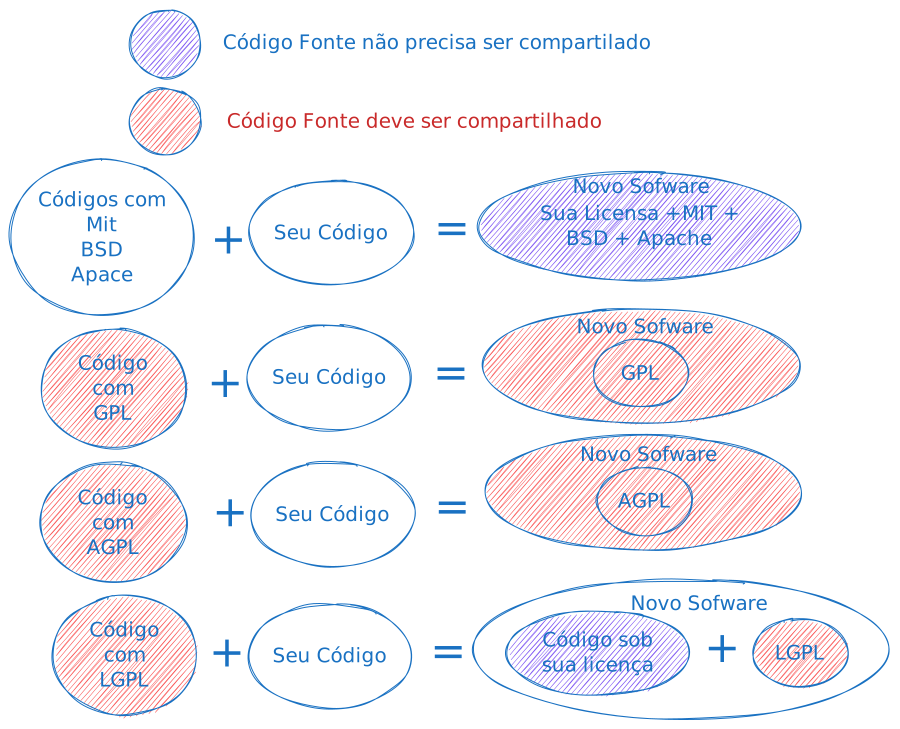
"Free software" means software that respects users' freedom and community. This doesn't mean you can do anything, otherwise it becomes chaos.
Damages

Not properly following license usage can create serious consequences for a company or person.
- Millions in moral damages and fees
- Loss of intellectual property
- Loss of productivity, as it will interrupt the normal software lifecycle for adjustments.
- Loss of revenue due to judicial interruption of product distributions
- Damaged reputation as a reliable software provider
How to do it correctly?
The best path is to have a legal department specialized in copyright. What will be shown below should not be used as a template, it is only an example of how we should reference a third-party license.
Let's imagine that our product solution uses Nginx which has its own license. How would we do this?
[Proprietary License]

This software (the "Software") is the exclusive property of [Company Name] and is protected by copyright laws and other applicable intellectual property laws. The use of this software is subject to the terms and conditions set forth in this license.

License grant:
a. [Company Name] grants the user a personal, limited, non-exclusive, non-transferable, and revocable license to use the Software and any related documentation materials, only for the user's internal purposes and in accordance with the terms and conditions of this license.
b. The Software includes the Nginx web server, which is licensed under the 2-clause BSD license, the terms and conditions of which are as follows:

"Copyright (c) [Year] Nginx, Inc.

Permission is hereby granted, free of charge, to any person obtaining a copy of this software and associated documentation files (the "Software"), to deal in the Software without restriction, including without limitation the rights to use, copy, modify, merge, publish, distribute, sublicense, and/or sell copies of the Software, and to permit persons to whom the Software is furnished to do so, subject to the following conditions:

The above copyright notice and this permission notice shall be included in all copies or substantial portions of the Software.

THE SOFTWARE IS PROVIDED "AS IS", WITHOUT WARRANTY OF ANY KIND, EXPRESS OR IMPLIED, INCLUDING BUT NOT LIMITED TO THE WARRANTIES OF MERCHANTABILITY, FITNESS FOR A PARTICULAR PURPOSE AND NONINFRINGEMENT. IN NO EVENT SHALL THE AUTHORS OR COPYRIGHT HOLDERS BE LIABLE FOR ANY CLAIM, DAMAGES OR OTHER LIABILITY, WHETHER IN AN ACTION OF CONTRACT, TORT OR OTHERWISE, ARISING FROM, OUT OF OR IN CONNECTION WITH THE SOFTWARE OR THE USE OR OTHER DEALINGS IN THE SOFTWARE."

By using Nginx, the user agrees to the terms and conditions of the 2-clause BSD license.

Restrictions:
a. The user may not sublicense, sell, rent, lease, transfer, or grant any other form of rights to third parties.
b. The user may not decompile, disassemble, reverse engineer, or otherwise attempt to derive the source code of the Software, except to the extent that such activity is expressly permitted by law.
c. The user may not remove, obscure, or alter any copyright notices, trademarks, or other proprietary information included in the Software.

Limited Warranty:
a. The Software is provided "as is" without any warranty, express or implied, including, but not limited to, warranties of fitness for a particular purpose, non-infringement, or implied warranties of merchantability or fitness for commercial use.
b. [Company Name] does not warrant that the Software will meet the user's requirements or that the use of the Software will be uninterrupted, timely, secure, or error-free.

Limitation of Liability:
a. Under no circumstances shall [Company Name] be liable for any direct damages,