Static Analysis
Static analysis checks source code without loading binaries. It's something we should do manually before the pipeline and at various pipeline stages for verification.
- Check code against rules.
- Some rules already exist and are provided by the collaborative community.
- We can create our own rules to stop pipelines when necessary, knowing that other rules will be checked, such as OPA.
We can check, for example, if:
- Resource limits for pods have been defined. It's always good to define them to prevent a pod from growing uncontrollably.
- The service account used is not the default, as it's not good to use the default to granularize permissions.
- We're referencing sensitive data through secrets. We shouldn't have sensitive values hardcoded directly in manifests as environment variables or ConfigMaps.
- Dockerfiles also don't have sensitive data.
- Etc.
Of course, everything depends on the project's use case and the company.
If we're going to put static analysis in a CI/CD pipeline, where can we place these analyses? Note that static analysis is at a moment before Deploy. From this moment we'll have another analysis, policy analysis.
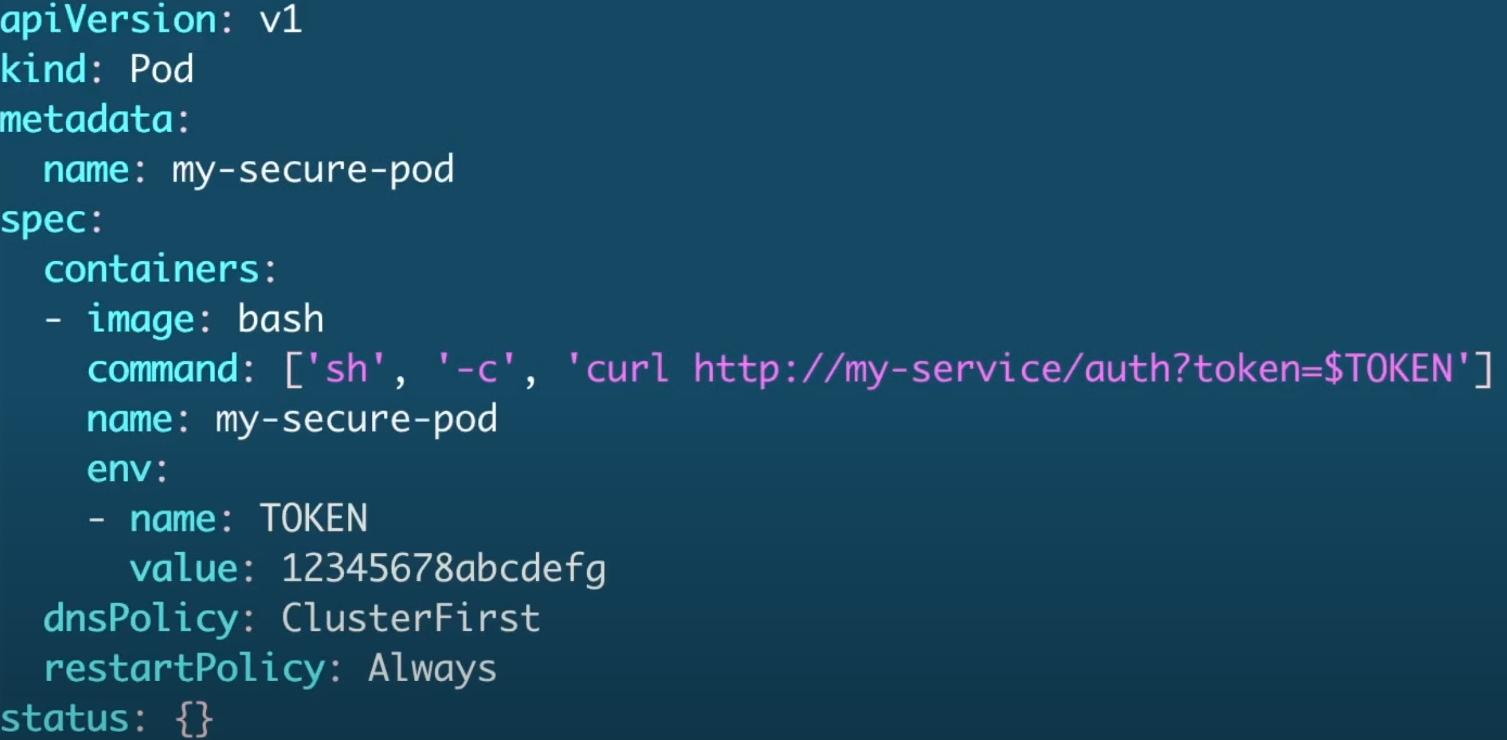
Let's analyze the manifest below manually, which would be the first stage of static analysis.
We can already observe that we're passing sensitive values hardcoded directly in the manifest, and this should never be done.

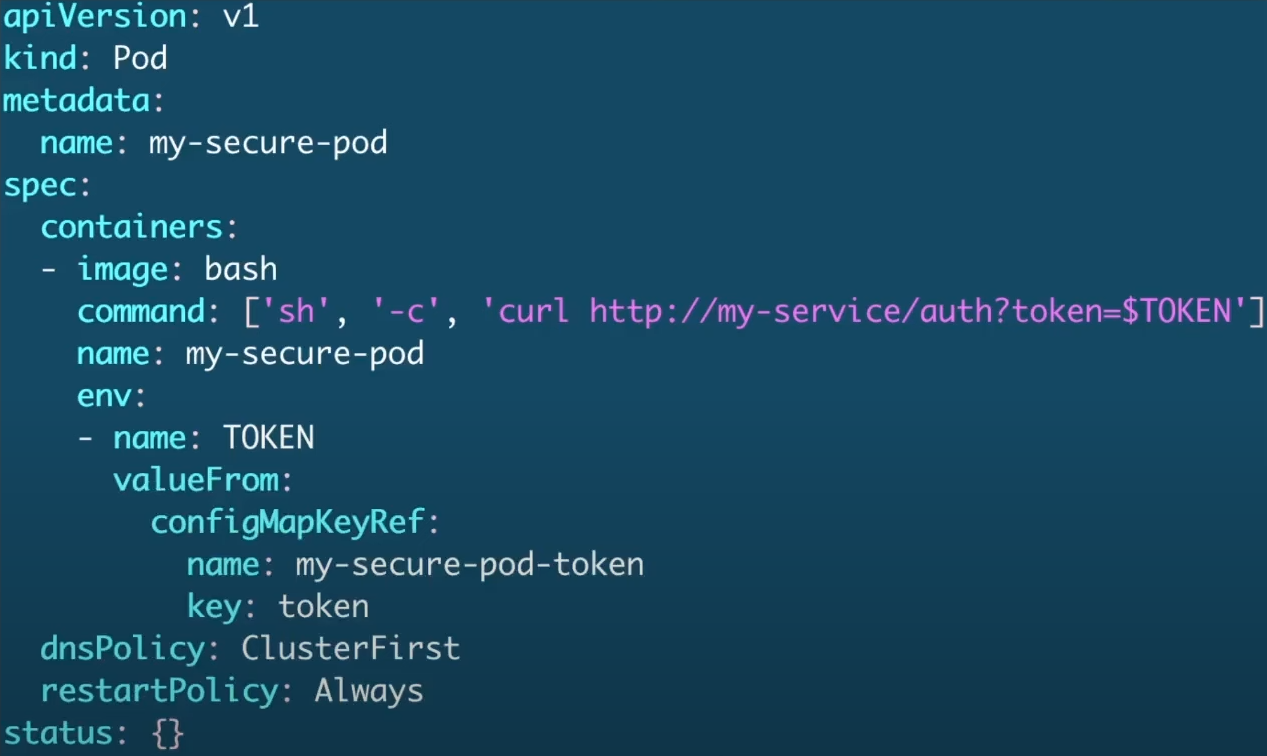
This only changes the reference, but it's clearly exposed.
This already looks better, but it's still not the best scenario, as we could use secrets. ConfigMaps are not secrets, they seem like it, but they're not!
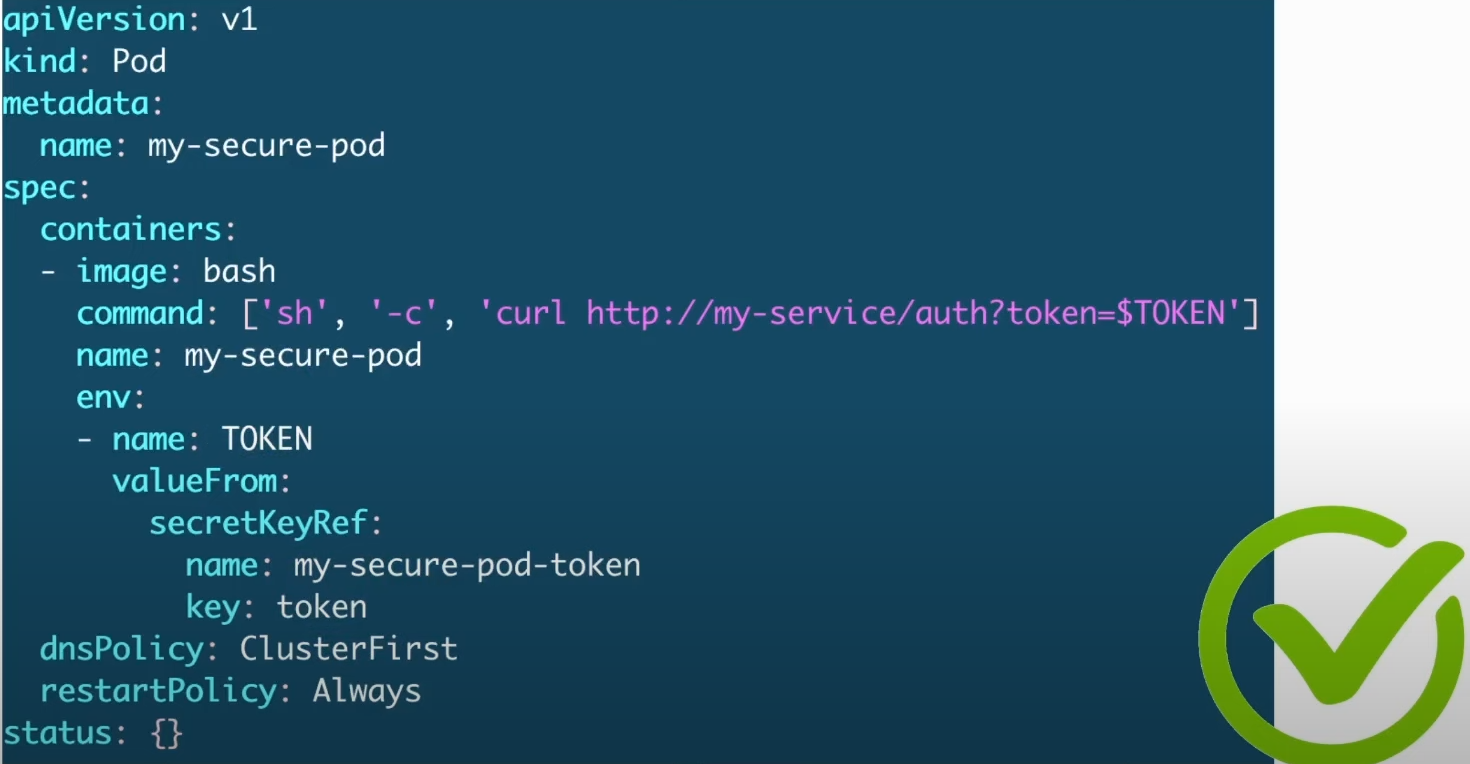
And this would be the best scenario. Secrets are stored with better security than ConfigMaps and can be encrypted. We also have other options for external secret management, but within CKS limits, this is it.
We can put plugins in our IDEs that can help during development, but not for the CKS exam.
Kubesec
Kubesec is an open-source tool that helps with risk analysis for Kubernetes resources.
It performs static analysis of the manifest and compares it against security best practices to give us improvement insights. The tool doesn't make corrections, only verification and report generation.
We can use kubesec through:
- Binary (local or pipelines)
- Docker Container (local or pipelines).
- Kubectl plugins
- Once the binary is installed, we can use it from within kubectl.
- Admission Controller (kubesec-webhook)
Knowing this, we can use it at various stages, from the moment we're developing and during CI and CD.
Let's test an analysis without installing the binary, just with docker.
root@cks-master:~# k run nginx --image=nginx -oyaml --dry-run=client > nginx.yaml

root@cks-master:~# cat nginx.yaml
apiVersion: v1
kind: Pod
metadata:
  creationTimestamp: null
  labels:
    run: nginx
  name: nginx
spec:
  containers:
  - image: nginx
    name: nginx
    resources: {}
  dnsPolicy: ClusterFirst
  restartPolicy: Always
status: {}

# Note that we'll analyze the file without creating the pod, it's not running in the system.

# Running with docker passing nginx.yaml as standard input.
root@cks-master:~# docker run -i kubesec/kubesec:512c5e0 scan /dev/stdin < nginx.yaml
Unable to find image 'kubesec/kubesec:512c5e0' locally
512c5e0: Pulling from kubesec/kubesec
c87736221ed0: Pull complete
5dfbfe40753f: Pull complete
0ab7f5410346: Pull complete
b91424b4f19c: Pull complete
0cff159cca1a: Pull complete
32836ab12770: Pull complete
Digest: sha256:8b1e0856fc64cabb1cf91fea6609748d3b3ef204a42e98d0e20ebadb9131bcb7
Status: Downloaded newer image for kubesec/kubesec:512c5e0
[
  {
    "object": "Pod/ngix.default",
    "valid": true,
    "message": "Passed with a score of 0 points",
    "score": 0,
    "scoring": {
    # Some advice...
      "advise": [
        {
          "selector": "containers[] .securityContext .readOnlyRootFilesystem == true",
          "reason": "An immutable root filesystem can prevent malicious binaries being added to PATH and increase attack cost"
        },
        {
          "selector": "containers[] .resources .limits .cpu",
          "reason": "Enforcing CPU limits prevents DOS via resource exhaustion"
        },
        {
          "selector": "containers[] .resources .requests .memory",
          "reason": "Enforcing memory requests aids a fair balancing of resources across the cluster"
        },
        {
          "selector": "containers[] .securityContext .runAsNonRoot == true",
          "reason": "Force the running image to run as a non-root user to ensure least privilege"
        },
        {
          "selector": "containers[] .resources .limits .memory",
          "reason": "Enforcing memory limits prevents DOS via resource exhaustion"
        },
        {
          "selector": ".spec .serviceAccountName",
          "reason": "Service accounts restrict Kubernetes API access and should be configured with least privilege"
        },
        {
          "selector": "containers[] .securityContext .runAsUser -gt 10000",
          "reason": "Run as a high-UID user to avoid conflicts with the host's user table"
        },
        {
          "selector": ".metadata .annotations .\"container.seccomp.security.alpha.kubernetes.io/pod\"",
          "reason": "Seccomp profiles set minimum privilege and secure against unknown threats"
        },
        {
          "selector": ".metadata .annotations .\"container.apparmor.security.beta.kubernetes.io/nginx\"",
          "reason": "Well defined AppArmor policies may provide greater protection from unknown threats. WARNING: NOT PRODUCTION READY"
        },
        {
          "selector": "containers[] .securityContext .capabilities .drop",
          "reason": "Reducing kernel capabilities available to a container limits its attack surface"
        },
        {
          "selector": "containers[] .resources .requests .cpu",
          "reason": "Enforcing CPU requests aids a fair balancing of resources across the cluster"
        },
        {
          "selector": "containers[] .securityContext .capabilities .drop | index(\"ALL\")",
          "reason": "Drop all capabilities and add only those required to reduce syscall attack surface"
        }
      ]
    }
  }
]
Implementing some improvements by adding resources, service account, and security context.
root@cks-master:~# vim nginx.yaml
root@cks-master:~# cat nginx.yaml
apiVersion: v1
kind: Pod
metadata:
  creationTimestamp: null
  labels:
    run: nginx
  name: nginx
spec:
  containers:
  - image: nginx
    name: nginx
    resources:
      requests:
        memory: "128Mi"
        cpu: "250m"
      limits:
        memory: "256Mi"
        cpu: "500m"
    securityContext:
      runAsNonRoot: true
  dnsPolicy: ClusterFirst
  restartPolicy: Always
status: {}

root@cks-master:~# docker run -i kubesec/kubesec:512c5e0 scan /dev/stdin < nginx.yaml
[
  {
    "object": "Pod/nginx.default",
    "valid": true,
    "message": "Passed with a score of 6 points",
    "score": 6, # The score improved
    "scoring": {
      "advise": [
        {
          "selector": "containers[] .securityContext .readOnlyRootFilesystem == true",
          "reason": "An immutable root filesystem can prevent malicious binaries being added to PATH and increase attack cost"
        },
        {
          "selector": "containers[] .securityContext .capabilities .drop",
          "reason": "Reducing kernel capabilities available to a container limits its attack surface"
        },
        {
          "selector": "containers[] .securityContext .capabilities .drop | index(\"ALL\")",
          "reason": "Drop all capabilities and add only those required to reduce syscall attack surface"
        },
        {
          "selector": "containers[] .securityContext .runAsUser -gt 10000",
          "reason": "Run as a high-UID user to avoid conflicts with the host's user table"
        },
        {
          "selector": ".metadata .annotations .\"container.seccomp.security.alpha.kubernetes.io/pod\"",
          "reason": "Seccomp profiles set minimum privilege and secure against unknown threats"
        },
        {
          "selector": ".metadata .annotations .\"container.apparmor.security.beta.kubernetes.io/nginx\"",
          "reason": "Well defined AppArmor policies may provide greater protection from unknown threats. WARNING: NOT PRODUCTION READY"
        }
      ]
    }
  }
]
Let's improve more...
cat pod-nginx.yaml
apiVersion: v1
kind: Pod
metadata:
  creationTimestamp: null
  labels:
    run: nginx
  name: nginx
spec:
  serviceAccountName: nginx
  containers:
  - image: nginx
    name: nginx
    resources:
      requests:
        memory: "128Mi"
        cpu: "250m"
      limits:
        memory: "256Mi"
        cpu: "500m"
    securityContext:
      runAsNonRoot: true
      runAsUser: 10001
      readOnlyRootFilesystem: true
      capabilities:
        drop:
        - ALL
  dnsPolicy: ClusterFirst
  restartPolicy: Always
status: {}
Checking...
root@cks-master:~# docker run -i kubesec/kubesec:512c5e0 scan /dev/stdin < nginx.yaml
[
  {
    "object": "Pod/nginx.default",
    "valid": true,
    "message": "Passed with a score of 12 points",
    "score": 12,
    "scoring": {
      "advise": [
        {
          "selector": ".metadata .annotations .\"container.seccomp.security.alpha.kubernetes.io/pod\"",
          "reason": "Seccomp profiles set minimum privilege and secure against unknown threats"
        },
        {
          "selector": ".metadata .annotations .\"container.apparmor.security.beta.kubernetes.io/nginx\"",
          "reason": "Well defined AppArmor policies may provide greater protection from unknown threats. WARNING: NOT PRODUCTION READY"
        }
      ]
    }
  }
]
Only apparmor and seccomp remain, which we'll see later in the course. Let's apply to see what we can run.
# Creating the service account we'll use
root@cks-master:~# k create sa nginx
serviceaccount/nginx created

root@cks-master:~# k apply -f nginx.yaml
pod/nginx created

root@cks-master:~# k get pods
NAME    READY   STATUS             RESTARTS     AGE
nginx   0/1     CrashLoopBackOff   1 (6s ago)   9s

# Let's find the problem
root@cks-master:~# k describe pod nginx
...
Conditions:
  Type                        Status
  PodReadyToStartContainers   True
  Initialized                 True
  Ready                       False
  ContainersReady             False
  PodScheduled                True
Volumes:
  kube-api-access-dfr9z:
    Type:                    Projected (a volume that contains injected data from multiple sources)
    TokenExpirationSeconds:  3607
    ConfigMapName:           kube-root-ca.crt
    ConfigMapOptional:       <nil>
    DownwardAPI:             true
QoS Class:                   Burstable
Node-Selectors:              <none>
Tolerations:                 node.kubernetes.io/not-ready:NoExecute op=Exists for 300s
                             node.kubernetes.io/unreachable:NoExecute op=Exists for 300s
Events:
  Type     Reason     Age                From               Message
  ----     ------     ----               ----               -------
  Normal   Scheduled  18s                default-scheduler  Successfully assigned default/nginx to cks-worker
  Normal   Pulled     17s                kubelet            Successfully pulled image "nginx" in 387ms (387ms including waiting). Image size: 71026652 bytes.
  Normal   Pulling    16s (x2 over 17s)  kubelet            Pulling image "nginx"
  Normal   Created    15s (x2 over 17s)  kubelet            Created container nginx
  Normal   Started    15s (x2 over 17s)  kubelet            Started container nginx
  Normal   Pulled     15s                kubelet            Successfully pulled image "nginx" in 357ms (357ms including waiting). Image size: 71026652 bytes.
  Warning  BackOff    14s (x2 over 15s)  kubelet            Back-off restarting failed container nginx in pod nginx_default(f9d3097e-95d4-4da2-a184-bb2e0d4907f4)

root@cks-master:~# k logs pods/nginx --tail 10
/docker-entrypoint.sh: Launching /docker-entrypoint.d/10-listen-on-ipv6-by-default.sh
10-listen-on-ipv6-by-default.sh: info: can not modify /etc/nginx/conf.d/default.conf (read-only file system?)
/docker-entrypoint.sh: Sourcing /docker-entrypoint.d/15-local-resolvers.envsh
/docker-entrypoint.sh: Launching /docker-entrypoint.d/20-envsubst-on-templates.sh
/docker-entrypoint.sh: Launching /docker-entrypoint.d/30-tune-worker-processes.sh
/docker-entrypoint.sh: Configuration complete; ready for start up
2024/09/02 19:35:05 [warn] 1#1: the "user" directive makes sense only if the master process runs with super-user privileges, ignored in /etc/nginx/nginx.conf:2
nginx: [warn] the "user" directive makes sense only if the master process runs with super-user privileges, ignored in /etc/nginx/nginx.conf:2
2024/09/02 19:35:05 [emerg] 1#1: mkdir() "/var/cache/nginx/client_temp" failed (30: Read-only file system)
nginx: [emerg] mkdir() "/var/cache/nginx/client_temp" failed (30: Read-only file system)
Following the rules, we lost some permissions that were bypassed by being root user, and we set the filesystem as readonly.
We need nginx to work this way. We could use an image prepared for the user as we saw previously, but let's try to solve it.
In all directories where it needs to write, we can create an emptydir to solve the problem.
For nginx configuration, we can create a configmap that will be in nginx at /etc/nginx/conf.d/ where it will look for nginx configurations and create other directories for nginx to write.
root@cks-master:~# vim configmap.yaml
root@cks-master:~# cat configmap.yaml
apiVersion: v1
kind: ConfigMap
metadata:
  name: nginx-config-map
data:
  default.conf: |
    server {
      listen 8080;
      server_name localhost;
      location / {
        root /usr/share/nginx/html;
        index index.html;
      }
    }
root@cks-master:~# k apply -f configmap.yaml
configmap/nginx-config-map created
root@cks-master:~# vim nginx.yaml
root@cks-master:~# cat nginx.yaml
apiVersion: v1
kind: Pod
metadata:
  creationTimestamp: null
  labels:
    run: nginx
  name: nginx
spec:
  serviceAccountName: nginx
  containers:
  - image: nginx
    name: nginx
    resources:
      requests:
        memory: "128Mi"
        cpu: "250m"
      limits:
        memory: "256Mi"
        cpu: "500m"
    securityContext:
      runAsNonRoot: true
      runAsUser: 10001
      readOnlyRootFilesystem: true
      capabilities:
        drop:
        - ALL
    volumeMounts:
    - name: nginx-cache
      mountPath: /var/cache/nginx
    - name: nginx-config
      mountPath: /etc/nginx/conf.d/default.conf
      subPath: default.conf
    - name: nginx-run
      mountPath: /var/run/
  volumes:
    - name: nginx-cache
      emptyDir: {}
    - name: nginx-config
      configMap:
        name: nginx-config-map
    - name: nginx-run
      emptyDir: {}
  dnsPolicy: ClusterFirst
  restartPolicy: Always
status: {}

root@cks-master:~# k apply -f nginx.yaml
pod/nginx created
root@cks-master:~# k get pods
NAME    READY   STATUS    RESTARTS   AGE
nginx   1/1     Running   0          3s
Going back to the apparmor and seccomp topic, let's solve it just to make it look good!
root@cks-master:~# vim nginx.yaml
root@cks-master:~# cat nginx.yaml
apiVersion: v1
kind: Pod
metadata:
  creationTimestamp: null
  labels:
    run: nginx
  name: nginx
  # Adding these annotations as requested by kubesec
  annotations:
    container.seccomp.security.alpha.kubernetes.io/pod: 'runtime/default'
    container.apparmor.security.beta.kubernetes.io/nginx: 'runtime/default'
spec:
  serviceAccountName: nginx
  containers:
  - image: nginx
    name: nginx
    resources:
      requests:
        memory: "128Mi"
        cpu: "250m"
      limits:
        memory: "256Mi"
        cpu: "500m"
    securityContext:
      runAsNonRoot: true
      runAsUser: 10001
      readOnlyRootFilesystem: true
      capabilities:
        drop:
        - ALL
        # When applying the pod we observe that starting from 1.30 the apparmor annotation will be deprecated and kubesec will probably need to adjust to look here.
      appArmorProfile:
        type: RuntimeDefault
    volumeMounts:
    - name: nginx-cache
      mountPath: /var/cache/nginx
    - name: nginx-config
      mountPath: /etc/nginx/conf.d/default.conf
      subPath: default.conf
    - name: nginx-run
      mountPath: /var/run/
  volumes:
    - name: nginx-cache
      emptyDir: {}
    - name: nginx-config
      configMap:
        name: nginx-config-map
    - name: nginx-run
      emptyDir: {}
  dnsPolicy: ClusterFirst
  restartPolicy: Always
status: {}

# Resolved at maximum score
root@cks-master:~# docker run -i kubesec/kubesec:512c5e0 scan /dev/stdin < nginx.yaml
[
  {
    "object": "Pod/nginx.default",
    "valid": true,
    "message": "Passed with a score of 16 points",
    "score": 16,
    "scoring": {}
  }
]

root@cks-master:~# k apply -f nginx.yaml
pod/nginx created
root@cks-master:~# k get pods
NAME    READY   STATUS    RESTARTS   AGE
nginx   1/1     Running   0          5s
root@cks-master:~# k logs pods/nginx --tail 5
2024/09/02 19:54:03 [notice] 1#1: OS: Linux 5.15.0-1067-gcp
2024/09/02 19:54:03 [notice] 1#1: getrlimit(RLIMIT_NOFILE): 1048576:1048576
2024/09/02 19:54:03 [notice] 1#1: start worker processes
2024/09/02 19:54:03 [notice] 1#1: start worker process 21
2024/09/02 19:54:03 [notice] 1#1: start worker process 22
We can install the binary and do the same thing
root@cks-master:~# wget https://github.com/controlplaneio/kubesec/releases/download/v2.14.1/kubesec_linux_amd64.tar.gz

root@cks-master:~# tar -xzvf kubesec_linux_amd64.tar.gz
CHANGELOG.md
LICENSE
README.md
kubesec

root@cks-master:~# chmod +x kubesec

root@cks-master:~# mv kubesec /usr/local/bin/

root@cks-master:~# kubesec version
version 2.14.1
git commit 2d31e51659470451e6c51cb47be1df9e103fb49d
build date 2024-08-19T11:48:06Z

# Just to compare with the docker version, we can't, probably that container was built directly with the project.

# Looking at the dockerhub page for kubesec, we saw that this image is 5 years old and is in the tool's official documentation. https://hub.docker.com/r/kubesec/kubesec/tags?page=&page_size=&ordering=&name=512c5e0
root@cks-master:~# docker run -i kubesec/kubesec:512c5e0 version
version unknown
git commit unknown
build date unknown

# It would be the same output as the command below, changing to the newer version.
# root@cks-master:~# docker run -i kubesec/kubesec:v2.14.1 scan /dev/stdin < nginx.yaml
root@cks-master:~# kubesec scan nginx.yaml
[
  {
    "object": "Pod/nginx.default",
    "valid": true,
    "fileName": "nginx.yaml",
    "message": "Passed with a score of 16 points",
    "score": 16,
    "scoring": {
      "passed": [
        {
          "id": "ApparmorAny",
          "selector": ".metadata .annotations .\"container.apparmor.security.beta.kubernetes.io/nginx\"",
          "reason": "Well defined AppArmor policies may provide greater protection from unknown threats. WARNING: NOT PRODUCTION READY",
          "points": 3
        },
        {
          "id": "ServiceAccountName",
          "selector": ".spec .serviceAccountName",
          "reason": "Service accounts restrict Kubernetes API access and should be configured with least privilege",
          "points": 3
        },
        {
          "id": "SeccompAny",
          "selector": ".metadata .annotations .\"container.seccomp.security.alpha.kubernetes.io/pod\"",
          "reason": "Seccomp profiles set minimum privilege and secure against unknown threats",
          "points": 1
        },
        {
          "id": "RunAsNonRoot",
          "selector": ".spec, .spec.containers[] | .securityContext .runAsNonRoot == true",
          "reason": "Force the running image to run as a non-root user to ensure least privilege",
          "points": 1
        },
        {
          "id": "RunAsUser",
          "selector": ".spec, .spec.containers[] | .securityContext .runAsUser -gt 10000",
          "reason": "Run as a high-UID user to avoid conflicts with the host's users",
          "points": 1
        },
        {
          "id": "LimitsCPU",
          "selector": "containers[] .resources .limits .cpu",
          "reason": "Enforcing CPU limits prevents DOS via resource exhaustion",
          "points": 1
        },
        {
          "id": "LimitsMemory",
          "selector": "containers[] .resources .limits .memory",
          "reason": "Enforcing memory limits prevents DOS via resource exhaustion",
          "points": 1
        },
        {
          "id": "RequestsCPU",
          "selector": "containers[] .resources .requests .cpu",
          "reason": "Enforcing CPU requests aids a fair balancing of resources across the cluster",
          "points": 1
        },
        {
          "id": "RequestsMemory",
          "selector": "containers[] .resources .requests .memory",
          "reason": "Enforcing memory requests aids a fair balancing of resources across the cluster",
          "points": 1
        },
        {
          "id": "CapDropAny",
          "selector": "containers[] .securityContext .capabilities .drop",
          "reason": "Reducing kernel capabilities available to a container limits its attack surface",
          "points": 1
        },
        {
          "id": "CapDropAll",
          "selector": "containers[] .securityContext .capabilities .drop | index(\"ALL\")",
          "reason": "Drop all capabilities and add only those required to reduce syscall attack surface",
          "points": 1
        },
        {
          "id": "ReadOnlyRootFilesystem",
          "selector": "containers[] .securityContext .readOnlyRootFilesystem == true",
          "reason": "An immutable root filesystem can prevent malicious binaries being added to PATH and increase attack cost",
          "points": 1
        }
      ],
      "advise": [
        {
          "id": "AutomountServiceAccountToken",
          "selector": ".spec .automountServiceAccountToken == false",
          "reason": "Disabling the automounting of Service Account Token reduces the attack surface of the API server",
          "points": 1
        },
        {
          "id": "RunAsGroup",
          "selector": ".spec, .spec.containers[] | .securityContext .runAsGroup -gt 10000",
          "reason": "Run as a high-UID group to avoid conflicts with the host's groups",
          "points": 1
        }
      ]
    }
  }
]
We ended up finding more improvements. We can observe that now it shows the items that passed, but we already have two more advises.
root@cks-master:~# vim nginx.yaml
root@cks-master:~# cat nginx.yaml
apiVersion: v1
kind: Pod
metadata:
  creationTimestamp: null
  labels:
    run: nginx
  name: nginx
  annotations:
    container.seccomp.security.alpha.kubernetes.io/pod: 'runtime/default'
    container.apparmor.security.beta.kubernetes.io/nginx: 'runtime/default'
spec:
  serviceAccountName: nginx
  automountServiceAccountToken: false # Added
  containers:
  - image: nginx
    name: nginx
    resources:
      requests:
        memory: "128Mi"
        cpu: "250m"
      limits:
        memory: "256Mi"
        cpu: "500m"
    securityContext:
      runAsNonRoot: true
      runAsUser: 10001
      runAsGroup: 10001 # Added
      readOnlyRootFilesystem: true
      capabilities:
        drop:
        - ALL
      appArmorProfile:
        type: RuntimeDefault
    volumeMounts:
    - name: nginx-cache
      mountPath: /var/cache/nginx
    - name: nginx-config
      mountPath: /etc/nginx/conf.d/default.conf
      subPath: default.conf
    - name: nginx-run
      mountPath: /var/run/
  volumes:
    - name: nginx-cache
      emptyDir: {}
    - name: nginx-config
      configMap:
        name: nginx-config-map
    - name: nginx-run
      emptyDir: {}
  dnsPolicy: ClusterFirst
  restartPolicy: Always
status: {}

root@cks-master:~# kubesec scan nginx.yaml
[
  {
    "object": "Pod/nginx.default",
    "valid": true,
    "fileName": "nginx.yaml",
    "message": "Passed with a score of 18 points",
    "score": 18,
    "scoring": {
      "passed": [
        {
          "id": "ApparmorAny",
          "selector": ".metadata .annotations .\"container.apparmor.security.beta.kubernetes.io/nginx\"",
          "reason": "Well defined AppArmor policies may provide greater protection from unknown threats. WARNING: NOT PRODUCTION READY",
          "points": 3
        },
        {
          "id": "ServiceAccountName",
          "selector": ".spec .serviceAccountName",
          "reason": "Service accounts restrict Kubernetes API access and should be configured with least privilege",
          "points": 3
        },
        {
          "id": "SeccompAny",
          "selector": ".metadata .annotations .\"container.seccomp.security.alpha.kubernetes.io/pod\"",
          "reason": "Seccomp profiles set minimum privilege and secure against unknown threats",
          "points": 1
        },
        {
          "id": "AutomountServiceAccountToken",
          "selector": ".spec .automountServiceAccountToken == false",
          "reason": "Disabling the automounting of Service Account Token reduces the attack surface of the API server",
          "points": 1
        },
        {
          "id": "RunAsGroup",
          "selector": ".spec, .spec.containers[] | .securityContext .runAsGroup -gt 10000",
          "reason": "Run as a high-UID group to avoid conflicts with the host's groups",
          "points": 1
        },
        {
          "id": "RunAsNonRoot",
          "selector": ".spec, .spec.containers[] | .securityContext .runAsNonRoot == true",
          "reason": "Force the running image to run as a non-root user to ensure least privilege",
          "points": 1
        },
        {
          "id": "RunAsUser",
          "selector": ".spec, .spec.containers[] | .securityContext .runAsUser -gt 10000",
          "reason": "Run as a high-UID user to avoid conflicts with the host's users",
          "points": 1
        },
        {
          "id": "LimitsCPU",
          "selector": "containers[] .resources .limits .cpu",
          "reason": "Enforcing CPU limits prevents DOS via resource exhaustion",
          "points": 1
        },
        {
          "id": "LimitsMemory",
          "selector": "containers[] .resources .limits .memory",
          "reason": "Enforcing memory limits prevents DOS via resource exhaustion",
          "points": 1
        },
        {
          "id": "RequestsCPU",
          "selector": "containers[] .resources .requests .cpu",
          "reason": "Enforcing CPU requests aids a fair balancing of resources across the cluster",
          "points": 1
        },
        {
          "id": "RequestsMemory",
          "selector": "containers[] .resources .requests .memory",
          "reason": "Enforcing memory requests aids a fair balancing of resources across the cluster",
          "points": 1
        },
        {
          "id": "CapDropAny",
          "selector": "containers[] .securityContext .capabilities .drop",
          "reason": "Reducing kernel capabilities available to a container limits its attack surface",
          "points": 1
        },
        {
          "id": "CapDropAll",
          "selector": "containers[] .securityContext .capabilities .drop | index(\"ALL\")",
          "reason": "Drop all capabilities and add only those required to reduce syscall attack surface",
          "points": 1
        },
        {
          "id": "ReadOnlyRootFilesystem",
          "selector": "containers[] .securityContext .readOnlyRootFilesystem == true",
          "reason": "An immutable root filesystem can prevent malicious binaries being added to PATH and increase attack cost",
          "points": 1
        }
      ]
    }
  }
]

root@cks-master:~# k apply -f nginx.yaml
pod/nginx created

root@cks-master:~# k get pods
NAME    READY   STATUS    RESTARTS   AGE
nginx   1/1     Running   0          3s